
Understanding local wind effects
By Reuben Hansen
One of the great attractions of flying in New Zealand is the ability to experience places that many people will never see. Mountain valleys, remote airstrips, farm paddocks and backcountry locations are all part of what makes this type of flying so rewarding.
However, these same environments also bring challenges that require careful consideration.
Before a flight into a farm strip or backcountry airfield, most pilots follow a familiar routine. We check the weather, determine whether our aircraft performance is suitable for the strip, and make a phone call to the landowner or strip operator. These conversations usually cover the practical considerations – whether the grass has been mown, whether the surface is firm or soft after recent rain, whether there is stock in the paddock, and whether any new fences, equipment or other obstacles have appeared since the last visit. In the case of an AOPA NZ fly-in, a lot of these items will be covered in the strip briefing, for PIC consideration.
These are all important questions and form part of sensible pre-flight planning. However, one factor that can have a significant effect on a strip operation is often harder to identify before arrival: the local wind behaviour.
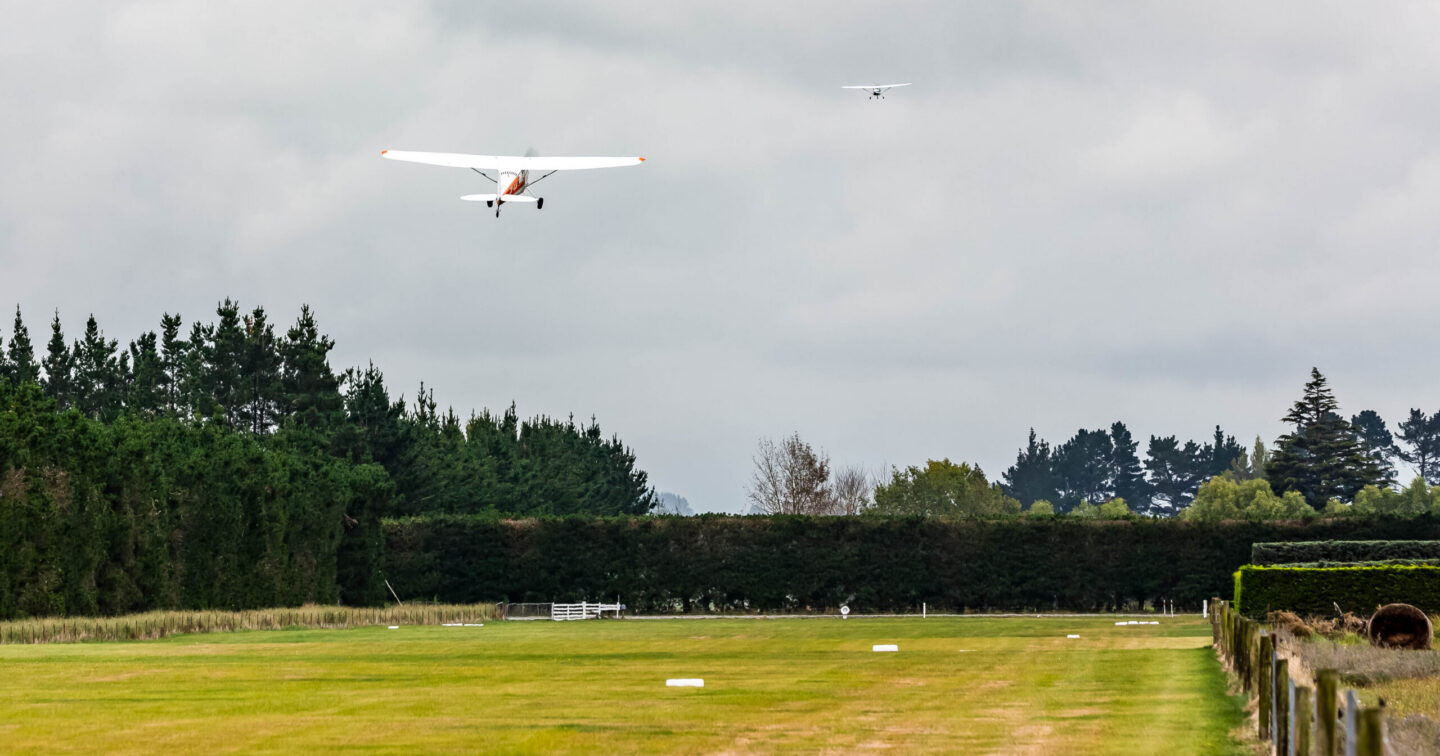
Flying into a strip environment requires a heightened level of awareness, where the runway itself is only one part of the operating picture. The surrounding landscape plays a significant role in shaping the conditions we encounter, with hills, valleys, shelter belts, ridges and even isolated farm buildings all capable of influencing the airflow around the aircraft. While local wind effects can also be present at larger aerodromes, they often have a greater impact on strip operations due to the combination of additional considerations involved.
Often, the challenge is not the wind indicated by the windsock, but the changes in airflow that occur around the surrounding landscape.
The windsock isn’t the whole story
A windsock remains one of the most valuable tools available to a pilot, but it is important to recognise its limitations. It provides an indication of the wind at one location on the strip, and only at that moment in time.
It cannot tell us what the airflow is doing half a mile back on final, over the crest of a nearby ridge, or behind a shelter belt protecting the runway.
Many private strips are located in terrain that has a significant influence on local airflow. Rolling hill country, valleys and tree-lined paddocks all modify the wind in ways that are not immediately obvious from the cockpit.
A pilot may observe a comfortable headwind at the windsock, only to encounter significant sink, turbulence or a sudden loss of headwind moments before touchdown.
Reading the landscape is just as important as assessing the strip itself. Before turning onto final, consideration should be given to where turbulence is likely to develop, whether the lee side of a ridge may produce rotor, and whether nearby trees or buildings could disturb the airflow close to the ground.
Reading the landscape
As we know, air behaves much like water flowing around rocks in a river. As it encounters obstacles it accelerates, changes direction, rises and descends. This helps explain why even modest terrain features can have a noticeable effect on an aircraft during the approach.
A ridge forces airflow upwards on the windward side before it descends on the lee side. Depending on the strength of the wind and the shape of the terrain, this descending air may be relatively smooth or develop into turbulent rotor. An approach that appears stable can quickly become unstable if the aircraft encounters unexpected sink close to the ground. How does this look? What cues are you looking for?
Terrain-induced winds also evolve throughout the day. On clear days, solar heating warms slopes and causes air to flow uphill, producing anabatic winds that generally strengthen through the afternoon. As the ground cools during the evening, this process reverses. Denser air drains downhill as katabatic winds, sometimes producing unexpected tailwinds or crosswinds in valleys and sheltered strips during the evening or early morning.
These local effects are not confined to mountainous areas. Coastal strips may experience afternoon sea breezes that differ markedly from the forecast gradient wind, while inland valleys often develop their own local circulations. A strip that offers a comfortable headwind approach early in the day may experience very different conditions only a few hours later, despite little apparent change in the regional weather. A lunch stop separating a landing and take-off might be the difference between a headwind for the landing developing into a reasonable crosswind for take-off. Unnoticed, this could bite.
The lesson is to consider not only the forecast wind, but also the time of day and how the surrounding terrain may modify it.
Local knowledge beyond the basics
In addition to getting permission to land, calling the strip owner before a flight is great airmanship, but it is worth considering the questions we ask. Most conversations naturally focus on the obvious: we ask about the condition of the strip, recent rain, grass length, stock, fences and other physical hazards. These are all important, they are visible and measurable. Less frequently do we ask about the local wind.
Yet the farmer who has lived on the property for thirty years will likely know that a north-westerly always tumbles over the ridge on short final, that the sea breeze reaches the strip by mid-afternoon, or that calm mornings often give way to a strong valley wind after lunch. This knowledge is invaluable. However, unless we ask, it is unlikely to be volunteered because the local operator simply considers it normal.
When planning a flight into an unfamiliar strip, consider adding a few simple questions to the conversation:
Are there any wind directions that cause problems?
Does the strip behave differently at certain times of the day?
Are there areas of turbulence that regularly catch visiting pilots by surprise?
The answers may prove just as valuable as knowing where the fences are.
The wind between the trees
Mechanical turbulence is another hazard that deserves respect.
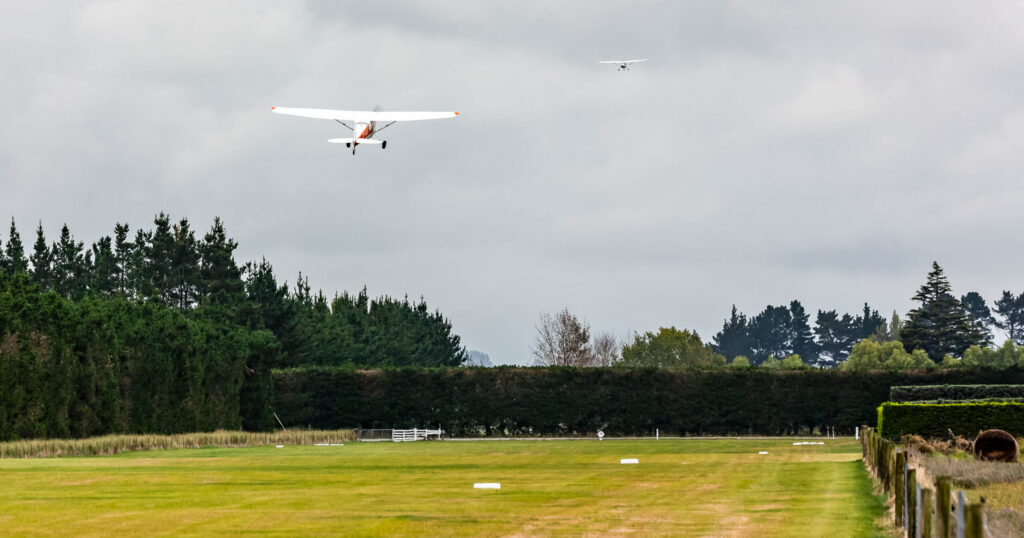
Shelter belts are common around New Zealand farms, protecting stock and crops from prevailing winds, and they can significantly alter the airflow around a strip. The wind may appear smooth on the upwind side of a tree line, yet become turbulent immediately beyond it. Even a modest reduction in headwind close to the ground can increase landing distance and result in a touchdown much further along the strip than planned.
The same applies to isolated buildings, bluffs and small ridges. Individually they may seem insignificant, but together they create an ever-changing pattern of airflow that is difficult to predict unless the pilot has consciously assessed the terrain before commencing the approach.
Developing a wind picture
Rather than relying on a single source of information, a mental picture of local wind effects can be developed. The weather forecast provides the broad overview, but it is only the starting point.
Along the route, smoke, ripples on water, moving cloud, bending trees and even other aircraft provide valuable clues. Combined with an understanding of the surrounding terrain, these observations allow us to continually refine our assessment of the conditions we are likely to encounter.
Importantly, this picture is never static. We need to constantly compare what we expected with what we are actually seeing. If the aircraft experiences more drift than anticipated, if the windsock differs from the forecast, or if turbulence develops earlier than expected, we can reassess the plan rather than pressing on regardless.
The approach is where it matters
Unexpected wind effects become most critical during the approach and landing, where there is little time or altitude available to recover. When significant sink, turbulence or changing wind conditions prevent the aircraft from remaining stabilised, the safest response may be to discontinue the approach and reassess. You might go around, and on the second attempt, the conditions that destabilised the approach may not be as pronounced, as this is the fickle nature of local, changeable winds.
The fundamentals – runway length, slope and surface condition – will always deserve careful consideration, but they are only part of the picture. The air above and around the strip is constantly being shaped by the landscape, the weather and the time of day. Those influences are often subtle, sometimes unpredictable, and almost always invisible.
The next time you plan a flight into an unfamiliar remote strip, don’t stop at asking whether the grass has been cut or whether the fences are clear.
Ask how the wind behaves.
Study the surrounding terrain.
Consider how the weather and time of day may influence the approach.
Because, the greatest hazard is often not the wind you can see.
It’s the wind you can’t.
Originally published in the Spring 2026 edition of our quarterly Approach magazine. Discover more stories, news and features by browsing our collection of past issues, all available to read online: AOPA NZ’s Approach magazine