
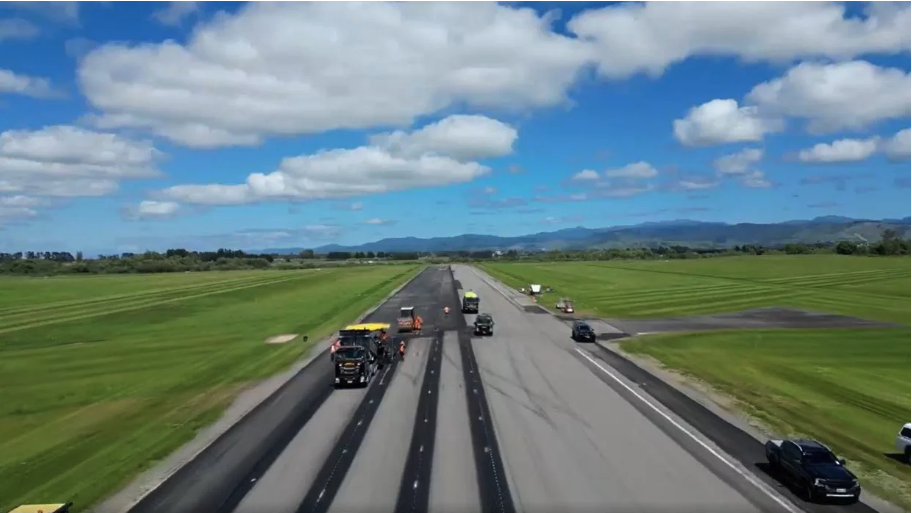
Roger Fairbrother is an AOPA NZ member and past member of the Executive who recently made submissions to the Masterton District Council in relation to works undertaking at the airport. For background, have a quick read of this article in the Post on 24 June: Airport runway falls short of gaining safety credential. Photo credit: Masterton Airport. Roger has modified his submissions slightly below to share with AOPA NZ members.
Background Information
Originally MDC was approached by Shane Jones representing the Labour Coalition under the Provincial Growth Fund. They had a “shovel ready project” and offered the MDC $10 million to improve Hood Aerodrome. One catch – they had to raise $7 million of their own money to complete this project. Work was meant to start early in January 2024 – the contractor turned up and guess what? Some nameless, faceless person had forgotten to get the resource consent. I think it was late March when work started and is still ongoing. The 28/10 runway has been closed ever since.
In 2017 I took a councillor to the aerodrome to meet with three airline pilots who had planes and hangars on the aerodrome. There was no follow up from that meeting and as far as I know no consultation with users on the project.
I think I could include myself in this group with my flying credentials.
Naturally a consultant was employed to do the planning and once again no consultation with users.
My submission
I started flying nearly 40 years ago and own a plane which is based at the Wairarapa Aero Club. I was a member of Flying NZ for many years and entered national competitions, after winning regional competitions to qualify, which were often held at Hood Aerodrome. I won several national titles. I was President of the Aero Club for nine years and served on the board of AOPA for three years.
When I started flying in Masterton all the runways were grass and you aimed at a mark on the horizon and opened the throttle. I think it is fair to say that as recreational pilots we enjoyed the airfield more then than we do now. When we were doing competitions we were able to line cars up on the side of the runway while we took turns at using the planes to compete. Over the years we have seen improvements made and it is interesting to note that the Air New Zealand Beech 1900s were able to use the sealed runway as it was before the service became uneconomic and they ceased operations.
As far as I understand nobody on the airfield was approached to give their views on airfield development. It is interesting to note that Taupo, which is a similar airport to ours, had Air New Zealand flying to Wellington, and since they left, Sounds Air and Origin Air have also been and gone.
The Masterton landing fees have not been reviewed for fourteen years – is this good business practice? The $7 million borrowed to complement the $10 million funded by the Provincial Growth Fund must have a daily cost of nearly $1000 at 5%. Do the councillors realise that Air Chathams’ operations are subsidised wherever they fly?
The landing fees for itinerant pilots –
Waipukurau – $0, Dannevirke – $0, Feilding – $10, Dannevirke – $0, Napier – $11.50,
Palmerston North – $18, Kapiti Coast – $14.76
Most airports seem to have a bulk rate for local operators, therefore with inflation having gone up 47% since 2011 I am proposing that we retain the bulk rate and increase it by 50% and the landing fee for itinerant aircraft is increased to $10. The honesty box system which is common throughout New Zealand at smaller airports should be retained as would be more cost effective than any other system.
A Group 2 aircraft at $18.98 per landing as is proposed and one landing a week would be at a cost of $986.96 per annum which is a more than significant increase on present day fees. At the moment there are 14 landings per day. My annual landing fee dated 01/07/24 to 30/06/25 is $184.
To summarise – I believe it is three months before the project will be finished. This process has been more than frustrating for all who use the airport and also those who hoped to use it through a national air service.
This article is a member contribution written by the author, and is for AOPA NZ members only (hence in the member-only section of our website). Member contributions represent the opinions of the author and not necessarily AOPA NZ. We may edit contributions down for brevity or other reasons.